How to Choose the Best Granite Support Blocks from China?

How to Choose the Best Granite Support Blocks from China?

Choosing the right granite support blocks from China requires more than comparing prices on a supplier website. These components must carry heavy stone safely, maintain stable spacing, and resist moisture, abrasion, and repeated handling. A block that looks strong in a product photo may still chip under load or vary in size between batches. Small differences matter.

This guide explains how to assess material quality, dimensions, load performance, surface finish, packaging, and supplier reliability. It considers common granite types, production methods, inspection records, and practical project requirements. For example, a polished countertop project may need clean edges and precise thickness, while outdoor landscaping may require rougher surfaces and stronger resistance to weather. Clear drawings, sample approval, and measurable tolerances can prevent costly misunderstandings.

Experience also shows that communication deserves careful attention. Confirm the stone origin, density, compressive strength, available sizes, and acceptable color variation before placing a large order. Ask for recent production photos, independent test documents, and a sample from the actual manufacturing line. Do not rely on promises alone.

No checklist is perfect. Supplier documents can be incomplete, and visual inspection cannot reveal every internal weakness. A sensible buyer combines technical review, sample testing, factory communication, and secure packaging plans. The goal is not simply to find inexpensive granite support blocks. It is to select dependable products from a capable Chinese supplier, with evidence supporting every important decision. That approach improves safety, consistency, and long-term project value.
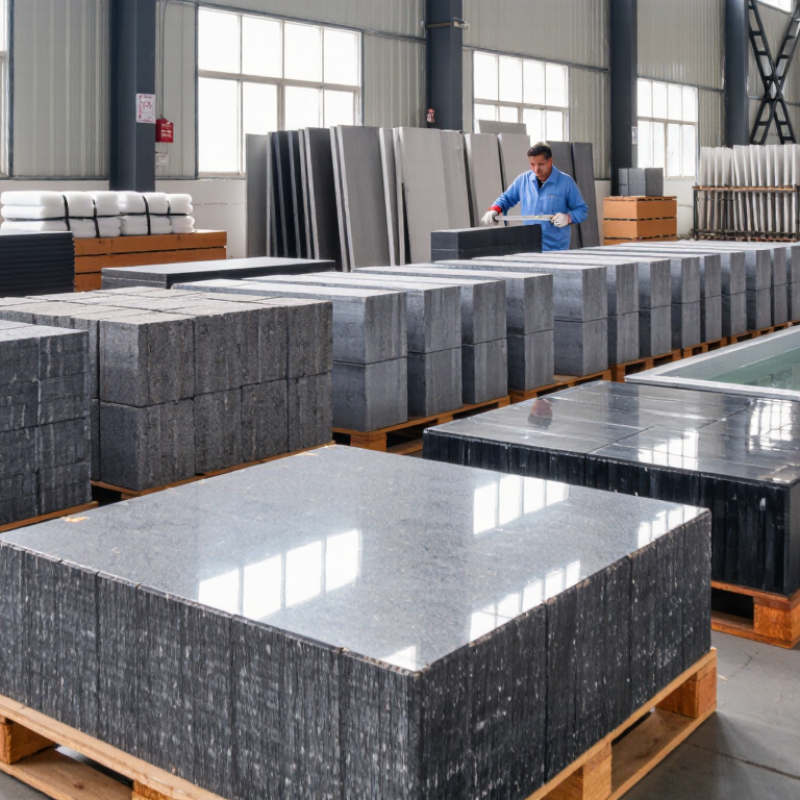
How to Choose the Best Granite Support Blocks from China?

Understanding Granite Support Blocks and Their Common Applications

How to Choose the Best Granite Support Blocks from China?

Granite support blocks are solid, load-bearing pieces used beneath slabs, equipment, monuments, and outdoor structures. Their main jobs are simple: distribute weight, reduce movement, and keep surfaces level. Common applications include countertop storage, stone fabrication, garden walls, machine bases, and temporary construction supports. The correct block depends on load, moisture exposure, dimensions, and surface finish. A block for indoor stone storage may need different tolerances than one supporting outdoor equipment.

Market data supports careful material selection. Grand View Research’s 2024 natural stone assessment projects industry growth of about 4.6% annually through 2030. The U.S. Geological Survey’s 2024 Mineral Commodity Summaries also identifies construction and architectural use as major drivers of dimension-stone demand. These figures do not prove that every granite block is suitable. They show why consistent quality matters when sourcing from China. Ask for density, water absorption, compressive strength, and dimensional-tolerance data. Request recent laboratory reports, not only a supplier’s brochure. Check corners for cracks, inspect the underside, and compare several samples. A polished surface can hide weak internal flaws.

Tips: Confirm the required load with an engineer. Specify length, width, height, and allowable variation in writing. Choose a rough or flamed contact face when slipping is a concern. Ask about packaging, moisture protection, and replacement procedures. One imperfect detail remains: visual inspection cannot reveal every fracture. Independent testing is worth the extra cost.

Identifying the Right Material, Size, and Load Capacity

Choosing granite support blocks from China begins with the working environment. Natural granite offers high compressive strength and stable support under heavy equipment. Dense, fine-grained stone usually resists chipping better than porous material. Ask for the granite grade, hardness, water absorption, and surface-flatness data. Do not rely on a polished photograph. Request a recent inspection report and a physical sample.

Size must match both the load footprint and the available installation space. Measure the contact area, anchor holes, and required clearance before requesting a quotation. A block that is too small concentrates pressure on one edge. A very large block may become difficult to position safely. For precision work, check length, width, height, parallelism, and flatness tolerances. I prefer drawings with millimetre dimensions, not verbal descriptions. Small details matter.

Calculate the expected load, then add a practical safety margin for vibration, movement, and uneven contact. Confirm the rated capacity applies to the full block, not one corner. Suppliers should explain their test method, loading direction, and failure criteria. Ask about edge chamfering, packaging, moisture protection, and replacement procedures. On arrival, inspect corners, cracks, dimensions, and visible warping before installation. I once accepted a block after checking only its top face; that was careless. Rechecking the underside would have prevented a costly delay. Production schedules can pressure decisions, but traceable measurements remain more reliable than promises.

Comparing Chinese Manufacturers and Production Standards

How to Choose the Best Granite Support Blocks from China?

China offers a broad range of granite support blocks, but factory comparison matters more than price. The U.S. Geological Survey’s 2024 Mineral Commodity Summaries identifies China as a leading global stone producer. However, production volume does not prove dimensional accuracy or long-term stability.

Ask manufacturers for block density, water absorption, compressive strength, and tolerance records. For precision applications, request inspection data from each production batch.

International standards provide a useful filter. ISO 9001 certification supports controlled processes, but it does not guarantee perfect granite blocks. ASTM C615 and EN 12407 offer relevant guidance for stone quality and petrographic examination.

Experienced buyers should check whether the supplier tests granite samples before cutting. Inspectors should also measure flatness with calibrated tools.

A 0.1-millimeter deviation can affect equipment alignment. Small details matter.

The ISO Survey reports China has the world’s largest number of ISO 9001 certificates, yet certificate validity still requires verification.

Tips:

Request three sample blocks from different batches. Compare weight, surface finish, corner protection, and measured tolerances.

Check the inspection date and testing laboratory. Ask for current documents, not screenshots.

Factory audits are useful, but they remain limited.

Even careful buyers can miss hidden variation inside natural stone.

Verifying Product Quality, Certifications, and Sample Results

Choosing granite support blocks from China requires evidence beyond polished surfaces and attractive prices. In practical inspections, I check edge squareness, visible fissures, flatness, and density consistency. A certificate alone proves little. The ISO Survey 2022 recorded 1,265,216 valid ISO 9001 certificates worldwide, yet quality systems do not guarantee every production batch. Ask for the supplier’s current certificate, scope, issuing body, and audit validity.

Request samples from the same material and process as the bulk order. Test compressive strength under ASTM C170/C170M, absorption under ASTM C97/C97M, and flexural strength under ASTM C880/C880M when bending loads matter. The laboratory should hold ISO/IEC 17025 accreditation. Check the report number, test date, specimen dimensions, conditioning method, and failure description. Results without these details are weak evidence.

Do not accept only a supplier-selected sample. Buy three to five blocks from separate cartons, then compare dimensions with digital calipers and a granite surface plate. A strong sample can still hide a weak batch. That is an uncomfortable possibility. USGS Mineral Commodity Summaries 2024 continues to classify granite within dimension stone, where import quality varies by source and application. I would specify a rejection limit before ordering, not after delivery. Also verify that packaging prevents corner damage during ocean transport, because a perfect laboratory result cannot repair a chipped support block.

How to Choose the Best Granite Support Blocks from China? - Verifying Product Quality, Certifications, and Sample Results

Evaluation Dimension Recommended Acceptance Criterion Verification Method Reference Sample Result Assessment Documents or Evidence to Request
Granite material grade Uniform fine- to medium-grained granite, free from structural cracks, open veins, and weak mineral zones. Review petrographic description and inspect the complete sample under bright, even lighting. Fine-grained black granite with even texture; no visible cracks or open pits on the working surface. Pass Material declaration, petrographic report, quarry/source traceability, and photographs of the actual batch.
Density Typically about 2.63–2.75 g/cm³ for sound granite; the purchase specification should define the permitted range. Determine density from measured mass and volume, or review a laboratory test report. 2.67 g/cm³ at laboratory test temperature. Pass Test method, specimen dimensions, measured mass, laboratory date, and authorized test signature.
Water absorption Preferably ≤0.50% by mass for precision support applications, unless the approved drawing states another limit. Oven-dry, water-saturate, and reweigh representative specimens using a documented laboratory procedure. 0.18% by mass. Pass Laboratory report showing dry mass, saturated mass, calculation, specimen identification, and test date.
Compressive strength A typical engineering screening value is ≥100 MPa for sound granite; the required value depends on block size and load. Review compressive-strength testing on representative granite specimens with documented loading direction. 178 MPa, dry condition; no visible splitting before the recorded failure load. Pass Test standard, specimen dimensions, loading rate, moisture condition, failure load, and calibration records.
Surface flatness ≤0.05 mm over each 100 mm inspection length for a precision support surface, unless a tighter drawing tolerance is required. Measure with a calibrated straightedge, feeler gauges, or a certified surface-measuring instrument. Maximum measured deviation: 0.032 mm over 100 mm. Pass Dimensional inspection report, measurement map, instrument serial number, and calibration certificate.
Parallelism and squareness Recommended maximum deviation: 0.05 mm per 100 mm for mating or stacked support blocks. Check opposite faces and side faces using a height gauge, granite reference surface, or coordinate measuring equipment. Parallelism deviation: 0.028 mm; squareness deviation: 0.035 mm per 100 mm. Pass Inspection report with datum definition, measurement locations, tolerance limits, and inspector approval.
Dimensional accuracy For a nominal 100 × 100 × 50 mm block, a practical starting tolerance is ±0.10 mm; confirm against the approved drawing. Measure all primary dimensions at multiple points with calibrated digital or mechanical gauges. Measured dimensions: 100.04 × 99.97 × 50.03 mm. Pass First-article inspection report, drawing revision, sampling plan, and nonconformance procedure.
Surface finish and edge condition Working face should be uniformly lapped or ground; no chips, raised areas, deep scratches, or sharp burr-like edges. Visual inspection plus surface-roughness measurement when the application requires controlled friction or contact. Uniform matte-lapped face; maximum edge chip 0.4 mm; no raised defects on the datum face. Pass Approved appearance standard, inspection photographs, surface-finish specification, and packaging protection plan.
Certification and quality system A current ISO 9001 certificate is useful for process control; the certificate scope must cover relevant manufacturing activities. Verify certificate number, validity, issuing certification body, scope, and audit status independently. Certificate copy provided; validity and scope pending independent verification before purchase order approval. Verify Current ISO 9001 certificate, audit summary, quality manual index, and document-control procedure. Product-specific requirements should not be replaced by a management-system certificate.
Sample approval and batch consistency Production units should match the approved sample in material appearance, dimensions, flatness, finish, and packaging. Approve a retained reference sample and perform pre-shipment inspection on randomly selected production pieces. 8 of 8 inspected pieces met dimensional and surface requirements; color and grain variation remained within the approved reference range. Pass Golden sample, inspection checklist, sampling level, lot identification, inspection photographs, and corrective-action records.

Note: The numerical values above are practical reference benchmarks for supplier screening. Final acceptance limits should be stated on the approved technical drawing, purchase specification, or applicable test standard for the intended load and accuracy requirements.

Evaluating Prices, Shipping, Customization, and Supplier Support

How to Choose the Best Granite Support Blocks from China?

Price is only the starting point when evaluating granite support blocks from China. A low quote may exclude reinforced crates, inspection fees, or port charges. Request a detailed quotation showing block dimensions, stone grade, load rating, packaging, and delivery terms. Compare the total landed cost, not just the factory price. Ask for recent test records and measured samples. Small dimensional differences can affect installation stability.

Shipping deserves equal attention. Granite is dense, so freight costs rise quickly when packaging wastes space. Confirm the gross weight, pallet design, moisture protection, and loading photographs before shipment. Sea freight is usually economical, but delivery schedules can shift. Build reasonable time into your project. I have seen buyers focus on price and underestimate storage charges after arrival. That mistake is expensive.

Customization can include thickness, drilled holes, edge finishing, surface texture, and protective pads. Send technical drawings with clear tolerances. Approve one physical sample before mass production. Supplier support matters after payment, too. Reliable suppliers answer technical questions, share production updates, and provide replacement solutions for verified defects. Check whether communication remains consistent during delays. A polished sales promise means little without written records. Some decisions still require compromise, especially between tighter tolerances and higher costs. Recognizing that trade-off early makes procurement more practical.

How to Choose the Best Granite Support Blocks from China?

Buyer evaluation of the four factors most commonly considered when sourcing granite support blocks: price, shipping, customization, and supplier support.

The 0–100 scores are normalized procurement benchmarks: higher values indicate stronger performance. Price competitiveness is based on expected landed-cost efficiency, while shipping reflects lead-time predictability, customization covers tolerance and packaging flexibility, and supplier support measures communication and after-sales responsiveness.

Article Source: