Choosing an Interactive Game Wall supplier in China involves more than comparing product photos or quoted prices. Buyers need to examine sensing accuracy, response time, installation requirements, content quality, and after-sales support. A wall that looks vivid in a catalog may behave differently in a bright, crowded venue. Small details matter: projector placement, floor glare, calibration time, and how quickly staff can restart a frozen game.
Play researcher Dr. Stuart Brown, founder of the National Institute for Play, has said, “The opposite of play is not work—the opposite of play is depression.” His observation offers a useful lens for evaluating interactive systems: the technology should invite genuine participation, not merely display motion. For suppliers, that means showing how children or visitors interact with the wall, how games adapt to different ages, and how the system performs during repeated daily use.
This guide compares leading Chinese suppliers through practical questions, not slogans. It considers product range, customization, hardware integration, project experience, and communication during delivery. Ask for live demonstrations, clear technical specifications, and references from comparable installations. Check what training and maintenance are actually included. Not every supplier publishes equally detailed evidence, and a polished video is not a substitute for an on-site test. The comparison also has limits: venue size, budget, and local service access can change which supplier is the best fit. A careful shortlist is a start, not a guarantee.
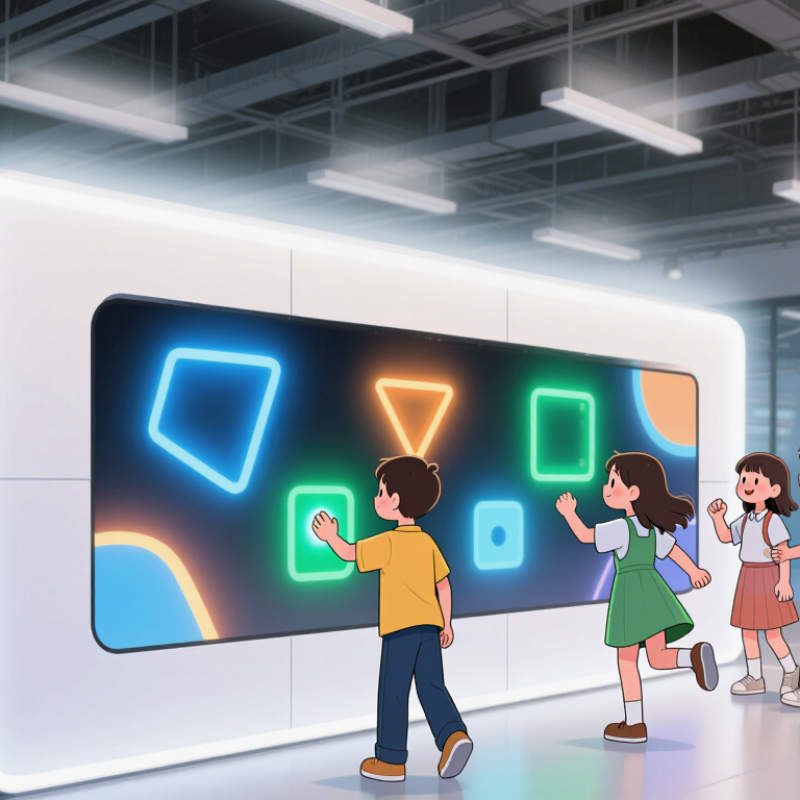
An interactive game wall is a large vertical display that turns touch or body movement into game controls. A player might tap glowing targets, swipe a hand across a projected maze, or step sideways to dodge a virtual obstacle. Behind the action, cameras or depth sensors track movement, while software updates the screen with immediate visual and sound feedback. Some walls use touch panels; others project onto a wall or purpose-built surface. They can support solo play or short, shared rounds in schools, family venues, and activity spaces. The idea is simple. Reliable tracking is not.
The wider interactive-display market gives useful context, though it does not measure game walls alone. MarketsandMarkets estimated that market at USD 45.8 billion in 2023 and forecast USD 75.5 billion by 2028. IDC’s Worldwide Augmented and Virtual Reality Spending Guide projected global AR/VR spending of USD 50.9 billion by 2026, an adjacent signal of investment in immersive experiences. These figures are not proof that every installation will engage visitors. Glare, delayed tracking, or unclear instructions can make a promising game frustrating. A useful wall needs readable graphics, quick feedback, and controls that work for different heights and movement abilities. Even then, the first version may need adjustment after watching real players use it.
An interactive game wall turns a flat surface into a shared play space. A projector casts images onto a wall or floor, while a depth camera tracks movement. Software maps each player’s position to on-screen actions: a hand tap might burst a virtual bubble, while a step redirects a ball. Short response times matter. Delays make the experience feel clumsy, especially for fast-moving games. Installers also need to manage ambient light, projection distance, floor grip, and safe play space.
These systems appear in family entertainment centers, museums, schools, and rehabilitation settings. In each, content and supervision should suit the users; a small play area needs simpler, slower games than a large public venue. Grand View Research’s 2024 interactive-display market report estimates the market at about US$41.6 billion in 2023 and projects continued growth through 2030. That is a broad category, not a game-wall sales figure, but it signals wider adoption of interactive surfaces. For buyers comparing suppliers, ask for a live demonstration under the venue’s actual lighting and flooring. Check calibration time, sensor coverage, content updates, and cleaning access. Easy to overlook. A bright projector alone cannot fix poor tracking, and a crowded installation may still frustrate visitors.
Who Are the Top Interactive Game Wall Suppliers in China?
China’s Interactive Game Wall Supplier Landscape
China’s supplier landscape includes display manufacturers, system integrators, and interactive-software teams. Some provide LED panels and touch sensors; others combine hardware, game content, installation, and maintenance. The distinction matters. A bright wall can still feel sluggish if tracking or calibration is poor.
The China Audio-Video and Digital Publishing Association reported 668 million game users and RMB 302.964 billion in domestic game-market revenue for 2023. These figures describe the wider gaming market, not interactive walls specifically. MarketsandMarkets estimated the global interactive-display market at USD 45.8 billion in 2023, forecasting USD 86.2 billion by 2028. This signals broader demand, but it does not identify China’s game-wall suppliers. The segment’s boundaries remain blurry. Buyers should compare measured touch latency, brightness under venue lighting, replacement-part availability, and software-update support—not just screen size.
Tips: Request a live demonstration using your own game content. Check tracking at the wall’s edges, then confirm who handles installation and repairs. Small details get missed.
A typical single-wall system configuration—not a supplier ranking or market-share estimate.
Interactive game wall projects commonly combine a display surface, image-rendering hardware, motion or touch tracking, interactive software, and audio. The quantities shown illustrate one example setup; actual specifications vary by project.
Notable interactive game wall suppliers in China typically specialize in different parts of a project. Some develop motion-sensing software, while others build projection systems, touch displays, or complete installations. A capable supplier should explain how its camera, projector, and software work together. Details matter. Ask for a live demonstration, not just a polished video.
For a venue operator, practical performance matters as much as visual impact. Check whether the wall responds to small movements, stays readable under bright lighting, and supports repeated play throughout a busy day. Request clear information about installation space, maintenance access, spare parts, and software updates. A sample floor plan can reveal problems before equipment arrives. Test it live.
Compare suppliers using the same requirements. Ask for project references, a written equipment list, and realistic delivery and setup timelines. If possible, speak with a past customer about response times after installation. Some proposals may look impressive but leave service responsibilities unclear. That is worth questioning. A short trial with several users can show whether controls feel natural and whether children and adults understand the game without lengthy instructions.
A practical comparison starts with the room, not the sales brochure. Measure the usable wall, ceiling height, viewing distance, and ambient light. Ask each supplier which projection or display setup fits those conditions. Check how the system responds when several players move at once. Is tracking smooth near the edges? Test it live. A short demonstration can reveal lag, missed touches, or distracting shadows. Request details about sensor calibration, frame materials, and expected maintenance. These specifics matter more than a long list of game titles.
Compare quotations line by line. Confirm what is included: installation guidance, software updates, staff training, spare sensors, and shipping protection. Ask for a written warranty and a clear response time for technical support. Request a video call showing the system running, then speak with a customer who has used it for several months. Look for consistent answers, not just polished promises. The cheapest option may leave out useful support; the highest price is not proof of quality. Some details will remain uncertain until installation, and that is worth discussing openly. A supplier who explains limits plainly is often easier to work with.
The profiles below compare common supplier types, not named companies or a verified ranking. Capabilities vary by project; confirm specifications, references, and service terms directly with each supplier.
| Supplier profile | Typical strengths | Points to verify | Best suited for | Useful comparison evidence |
|---|---|---|---|---|
| Interactive-display manufacturer | May provide display hardware, touch components, and enclosure options from one production source. | Confirm touch technology, simultaneous touch performance, protective-glass specifications, and whether game software is included or supplied separately. | Projects where display construction, size, or enclosure customization is a major requirement. | Request a component list, product drawings, operating test video, and a written hardware warranty. |
| Audio-visual system integrator | Can coordinate displays or projectors with computers, audio, mounting, cabling, and on-site installation. | Check which components are supplied directly, who is responsible for system integration, and whether installation and commissioning are available at the destination. | Venues needing a complete installed system rather than hardware alone. | Ask for a system diagram, itemized bill of materials, installation scope, and acceptance-test criteria. |
| Interactive-game software developer | May offer game design, interactive content, localization, and software changes for a particular audience or venue. | Confirm hardware compatibility, supported languages, software ownership or licensing, update terms, and what happens if the software needs maintenance. | Projects where customized gameplay or branded venue content is more important than bespoke hardware. | Request a live demo, game list, compatibility requirements, license terms, and a written description of customization limits. |
| Custom hardware-and-software integrator | May coordinate a tailored combination of display, sensing, computer hardware, software, and enclosure design. | A custom solution can require more engineering time. Clarify project milestones, change-control costs, component substitutions, and responsibility for each subsystem. | Non-standard layouts, venue-specific interactions, or projects requiring several technologies to work together. | Request a prototype plan, interface specifications, milestone schedule, and documented system-level test results. |
| Education or family-entertainment solution provider | May focus on group activities, age-appropriate content, and use in schools, museums, or family venues. | Check content suitability, accessibility options, language support, data collection practices, and whether the games can be configured for the intended setting. | Learning spaces, museums, community facilities, and family-oriented attractions. | Ask for a content catalogue, audience guidance, accessibility details, and a demonstration using the proposed equipment. |